 ELECTRONAUTICS
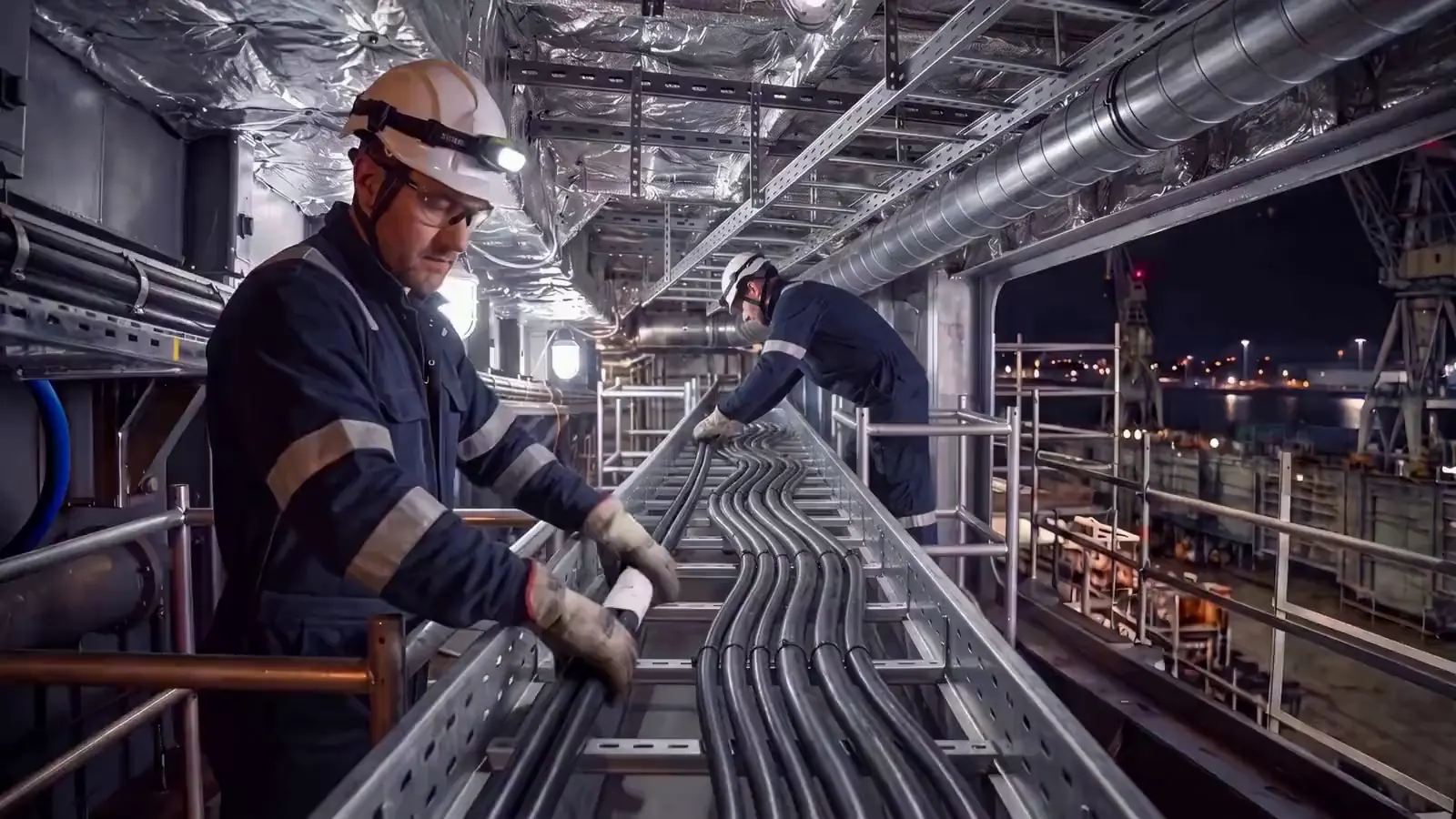
When pulling cables on a ship, each cable is laid on prepared cable trays according to the cable list, fixed, routed through bulkheads and decks, and marked. The installation standard IEC 60092-352 and the rules of the classification society apply. Knowing the rules saves rework at acceptance.
01Which standard applies to cable pulling on ships?
IEC 60092-352 and the classification society rules named in the shipbuilding contract. The 2005 edition of IEC 60092-352 was withdrawn on 23 October 20252. It was replaced by Edition 4.0 of October 2025, with the new title ‘Selection, installation, and operating conditions of cables’. It covers voltages up to 18/30 (36) kV and adds new requirements for category cables up to 1000 MHz, for optical fibre cables and for transitions into hazardous areas3.
On top of this come the class rules, for example Lloyd's Register Part 6, Chapter 2, Section 114, and the requirements of IACS, the umbrella association of the classification societies5. Class rules can have stricter or different values from the IEC. The shipbuilding contract states which edition and which class apply. That is the first question before any cable pulling.
02What bending radius applies to marine cables?
The cable manufacturer's value, but never less than the table value in the standard. For cables up to 1.8/3 kV, the 2005 edition of IEC 60092-352 gives these minimum radii, each as a multiple of the overall cable diameter D1:
| Cable type | Minimum bending radius |
|---|---|
| unarmoured, unbraided, up to 25 mm diameter | 4D, with circuit integrity 6D |
| unarmoured, unbraided, over 25 mm diameter | 6D |
| with braided screen or armour | 6D |
| wire- or tape-armoured, metal-sheathed | 6D |
| with polyester/metal laminate tape screen | 8D |
| with sector-shaped conductors | 8D |
| mineral-insulated | 6D |
For cables from 3.6/6 kV, the values are 12D for single-core and 9D for three-core cables1. Lloyd's Register gives the same values for high-voltage cables4. The cable manufacturer Prysmian recommends keeping to 1.5 times the table value during installation9. Watch the radius closely when pulling cables round corners and through penetrations.
03How do you pull cables without damaging them?
With limited pulling force, and not when it is too cold. Prysmian gives a maximum pulling force of 50 N per mm² of total conductor cross-section9. For a cable with three conductors of 95 mm² each, that is 285 mm² × 50 N/mm², or about 14 kN. According to the manufacturer, cables with a thermoplastic sheath should not be installed below −15 °C; pre-warmed, they can also be installed at lower temperatures9.
04How are cables fixed, and when are metal clips required?
On horizontal cable trays, the cables rest on supports no more than 400 mm apart and are fixed at least every 900 mm1. Lloyd's Register gives the clip spacing by cable diameter4:
| Cable diameter | max. clip spacing, unarmoured | max. clip spacing, armoured |
|---|---|---|
| up to 8 mm | 200 mm | 250 mm |
| 8 to 13 mm | 250 mm | 300 mm |
| 13 to 20 mm | 300 mm | 350 mm |
| 20 to 30 mm | 350 mm | 400 mm |
| over 30 mm | 400 mm | 450 mm |
Where the cables rest on a cable tray, Lloyd's Register permits up to 900 mm4.
On metal clips, the rule sets differ. The purpose is the same in all of them: in a fire, cables must not fall, injure people or block escape routes.
| Rules | Requirement |
|---|---|
| IEC 60092-352:2005 | Where cables fixed with plastic ties are not on a horizontal tray, for example running vertically or under the tray, additional metal clips are required at intervals of no more than 1 m. In areas with a high fire risk and in escape routes, clips and straps must be metal1. |
| Lloyd's Register | Where plastic clips are used, supplementary metal clips are required at intervals of no more than 2 m. Plastic fixings must be flame-retardant4. |
| IACS UR E16 | Plastic cable trays and ducts must be type-tested and have metal fixings, as a rule at least every 2 m. Fill ratio no more than 40 per cent, UV-protected on deck5. |
So there is no single value. The class and the edition of the standard in the shipbuilding contract govern. If the shipyard has its own in-house standards, these apply as well. The safest way is to agree the spacing in writing before work starts.
05How do you segregate power, signal and high-voltage cables?
By cable category and with spacing, with high voltage always kept separate. IEC 60533 divides cables into four categories: power; signal and control; radio and video; high power and converters. Where cables of different categories run in parallel for more than 1 m, it recommends at least 10 cm spacing, and at least 20 cm between signal and converter cables, if the cables are no more than 5 cm above the ground plane. Otherwise it recommends heavily screened cables or metal conduits with a wall thickness of at least 1 mm8. These values are in the informative Annex B of IEC 60533. They are a recommendation, not a requirement. The specification decides whether they become binding.
There is no leeway for high voltage. High-voltage cables are not run in the same bunch, duct, pipe or box as low-voltage cables, nor on the same cable tray as cables up to 1 kV. In accommodation spaces they run in enclosed cable ducts5,10.
Further rules from the standard and from Lloyd's Register1,4:
- Cables with different permissible conductor temperatures do not belong in the same clip, penetration or duct.
- Redundant supplies to essential consumers run on separate routes.
- At hull expansion joints, the cable needs a loop with an inner radius of at least 12D.
- Single-core AC cables of one circuit are laid close together, no more than one cable diameter apart. No magnetic material may lie between them. Above 250 A, a clearance of at least 50 mm from steel is required, except when laid in trefoil.
- If more than six cables that are fully loaded at the same time are bunched without air circulation, their current-carrying capacity drops. Lloyd's Register applies a factor of 0.85 for this. Signal cables are exempt.
06What applies to cable penetrations through bulkheads and decks?
They must not weaken the watertightness or fire protection of the bulkhead. Penetrations through watertight bulkheads and decks must be watertight themselves. Cables passing through decks must be protected up to a sufficient height1. Under Lloyd's Register rules, holes in non-watertight bulkheads are fitted with a bush, unless the steel is at least 6 mm thick and the edges are rounded4.
For watertight transits, the building yard keeps a register in accordance with IACS UR Z23. It lists marking, manufacturer's manuals, type approvals, installation drawings and the condition after final inspection. The surveyor checks installation, fixing, type approval and register. This applies to newbuildings with a shipbuilding contract dated 1 July 2021 or later6. At class renewal, all transits are examined again. Anyone who opens and repacks a transit must restore it to the manufacturer's instructions and the type approval7.
A type approval applies to a specific system and can be limited to specific installation situations. One DNV approval for a transit system, for example, only covers installation in sandwich panels12. So a frame is not automatically watertight or A-60 just because the system has an approval.
A-60 means the division withstands fire for 60 minutes, and on the unexposed side the average temperature rise is no more than 140 K, with no point rising by more than 180 K13. A penetration in such a division must meet these values as well.
07How are cables marked on board?
To the system set out in the specification. IEC 60092-352:2005 provides for marking of the cable ends where this is required1. High-voltage cables must be marked distinctly so that they are easy to identify4,10. For each distribution board there is a circuit list showing the cable type11. We did not find a general marking system in the rule sets cited. Whether cables are marked at both ends and at penetrations, and with which label material, therefore belongs in the specification.
08What mistakes happen during cable pulling?
These mistakes follow directly from the rules:
- Bending radius below the minimum during pulling, especially with high-voltage cables (12D, 9D) and foil-screened cables (8D).
- Only plastic ties on vertical runs, under trays or in escape routes.
- Pulling force exceeded, or cables with a thermoplastic sheath laid below −15 °C.
- Cables of different temperature classes in the same penetration.
- Transit not packed to its type approval, register and installation data missing.
- Signal and power cables without spacing run in parallel, screens not terminated.
- High voltage in the same bunch or on the same tray as low voltage.
- Redundant supplies on one tray, no loop at expansion joints.
- Ducts overfilled, more than 40 per cent.
- Single-core AC cables spread apart or with steel between them.
09What should be agreed before cable pulling starts?
- Edition of the standard and class from the shipbuilding contract
- Cable list with type, cross-section, length, start and end point of every cable
- Status of cable trays and brackets: installed, coated, accepted
- Spacing of metal clips and the shipyard's in-house standards
- Who packs the transits and supplies the data for the register
- Marking system and label material
- Storage space for the cable drums, access routes, temporary site power and lighting
- Which tests follow cable pulling and who records them
10How we do it at Electronautics
We take on cable trays and brackets, main-run and local cable pulling. Each cable is laid individually, fixed and marked. Our certified welders weld brackets for cable trays, penetrations and earthing studs on board to EN ISO 9606-1. At the end we test with test reports, and fibre optic cables with OTDR. Shipyards award cable pulling to us as a work package with our own crew and site manager, or bring electricians into their own team through temporary staffing.
Good cable pulling starts with the question of which edition of the standard and which class apply. After that, bending radius, fixing, segregation and properly made penetrations decide whether acceptance goes smoothly. Values on which the rule sets differ belong in the specification before work starts.
Important
The figures in this article come from the 2005 edition of IEC 60092-352, the Lloyd's Register rules (July 2022 edition), IACS requirements, IEC 60533, documents from the Danish Maritime Authority and manufacturer data. The edition of the standard and the class rules named in your shipbuilding contract are binding.
Questions about this article: info@electronautics.de
Sources
- IEC 60092-352:2005, 3rd edition, Choice and installation of electrical cables (full text) law.resource.org ↗
- IEC Webstore: IEC 60092-352:2005, withdrawn on 23 October 2025 webstore.iec.ch ↗
- IEC 60092-352:2025, Edition 4.0, contents and changes cdn.standards.iteh.ai ↗
- Lloyd's Register, Rules for Ships, Pt 6 Ch 2 Sec 11 ‘Electric cables’ (July 2022 edition) imorules.com ↗
- IACS: Requirements concerning electrical and electronic installations, including UR E11 and E16 (as of 09/2023) safety4sea.com ↗
- IACS UR Z23 Rev.7 Corr.1 (October 2022) classnk.or.jp ↗
- IACS UR Z28: Surveys of Watertight Cable Transits iacs.s3.af-south-1.amazonaws.com ↗
- IEC 60533:2015, Edition 3.0, EMC on ships with a metallic hull law.resource.org ↗
- Prysmian: Marine Cable Catalogue North Europe dk.prysmian.com ↗
- IEC 60092-503:2007, systems above 1 kV up to 15 kV law.resource.org ↗
- IEC 60092-201:2019, Edition 5.0, System design law.resource.org ↗
- DNV type approval TAF0000147 Rev.2 for a cable transit system cdn.content-publisher.roxtec.com ↗
- Danish Maritime Authority: Notice D II-2 A on A- and B-class divisions (2007) dma.dk ↗
As of 17 October 2026