 ELECTRONAUTICS
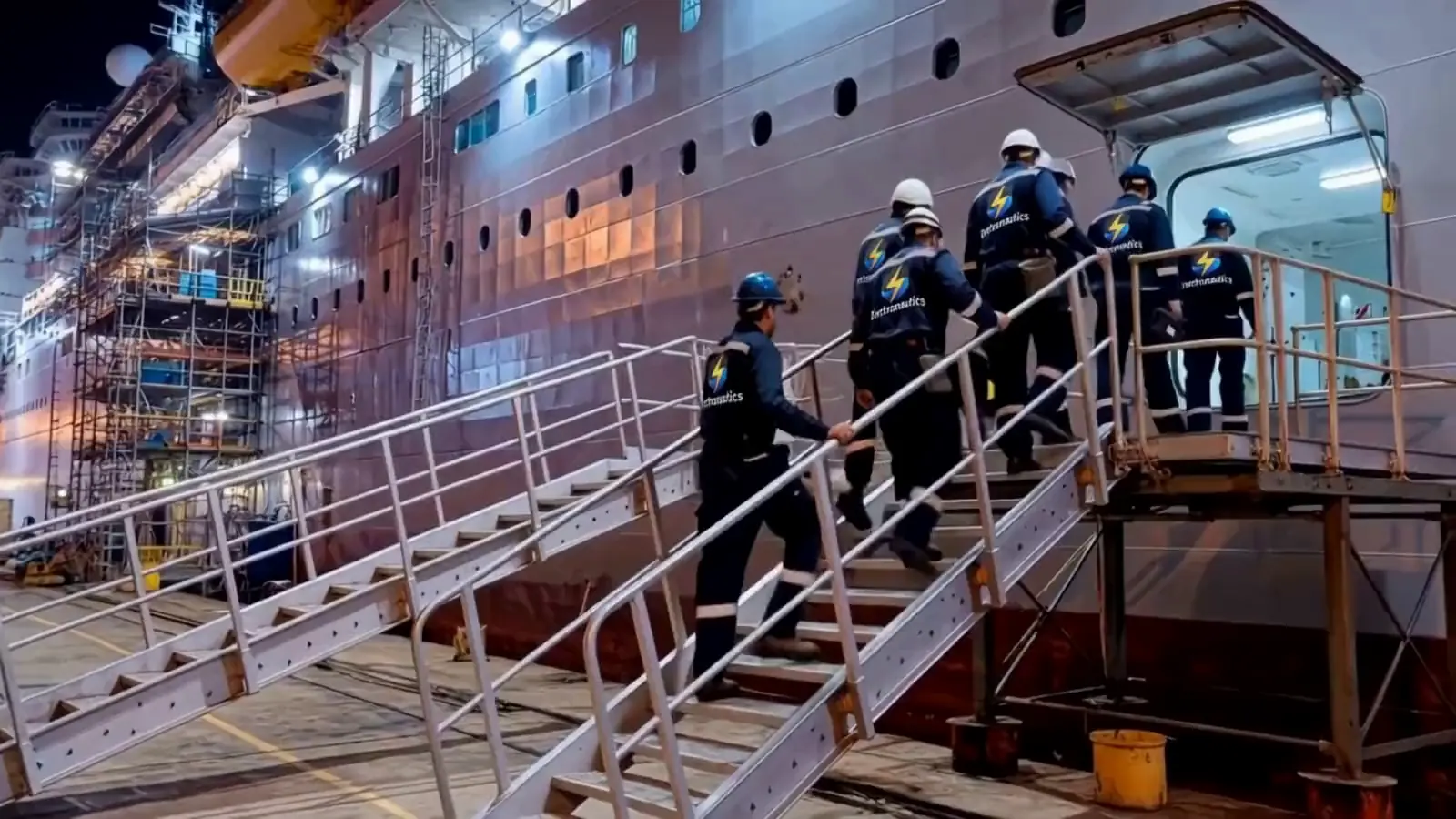
For electrical work at the shipyard there are two common routes: the shipyard awards a defined work package under a work contract, or it brings electricians into its own team through temporary staffing. Both routes are legal, and both have clear rules. Anyone who confuses or mixes them risks fines and, in the worst case, unintended employment relationships.
01How do you tell a work contract from temporary staffing?
By the right to give instructions and by the result owed. Temporary staffing exists when the workers are integrated into the client's work organisation and are subject to the client's instructions1. Under a work contract, the contractor owes a result and directs its own people.
The Federal Employment Agency (Bundesagentur für Arbeit) lists typical features of a work contract2:
| Points to a work contract | Points against a work contract |
|---|---|
| a clearly definable work result | many small tasks, each ordered individually |
| the contractor decides for itself how it works | simple tasks without a result of their own |
| it gives its own people their instructions | the client instructs the people directly on when and how they work |
| it bears the business risk and is liable for defects | the people are integrated into the client's operations |
| invoicing is by result, and there is an acceptance | invoicing is by the hour only |
The Agency looks at the overall picture, not at a checklist. As an example of a suspicious split into very small orders, it expressly names “welds”2. Applied to electrical work: “Cable pulling deck 5 to 7 to the cable list, with marking and test report” is a work result. “Three electricians whom the shipyard's foreman assigns every morning” is temporary staffing.
02When is a work contract the right choice?
When the scope is clearly described and the contractor can manage it itself. Typical examples are work packages such as cable pulling in one area to the cable list, connecting a switchboard or a bridge refit. The contractor then provides the crew and the site manager, does its own planning and hands over the result with acceptance and test reports.
What goes wrong is usually the practice on site: if the shipyard's foreman assigns the contractor's people directly, signs off their timesheets and sets their breaks, the work contract has quietly turned into temporary staffing.
03When is temporary staffing the right choice?
When the shipyard or the electrical contractor mainly needs people who work in its own team and to its own instructions. Then temporary staffing is the proper route, with these rules from the AÜG1:
- Licence: The staffing provider needs a licence from the Federal Employment Agency.
- Designation and naming: Before the assignment starts, the contract must be expressly designated as temporary staffing (Arbeitnehmerüberlassung), and each worker supplied is named individually.
- No chain leasing: Only the worker's own employer may hire them out.
- Maximum duration: 18 consecutive months with the same hirer. Earlier assignments count towards this if the break between them was no more than three months. A collective agreement in the industry where the worker is deployed can provide otherwise.
- Equal pay: In principle from the first day. If a collective agreement for temporary agency work applies, this may be departed from for the first nine months, and for longer under an industry surcharge agreement.
- Contract in text form: In it, the staffing provider declares that it holds the licence, and the hirer states the activity, the qualification required and the conditions of comparable permanent staff.
04What is a sham work contract, and why does a licence not help?
A sham work contract (Scheinwerkvertrag) is called a work contract but is carried out like temporary staffing. This is prohibited, even if the provider holds a licence for temporary staffing. The law requires temporary staffing to be designated as such in advance. If this is missing, the contract is invalid1.
The consequences hit both sides. An employment relationship with the hirer is then deemed to exist, unless the worker objects. On top of that, there are fines of up to €30,000, including for the hirer1. The Federal Employment Agency makes clear that a staffing provider who supplies people under a merely formal work contract is treated no better than one without a licence2. A licence held “just in case” therefore offers no protection.
05Does the construction industry ban also apply at the shipyard?
As a rule, no. The AÜG prohibits temporary staffing into construction businesses for work normally done by manual workers1. Whether a business counts as a construction business is determined by the Baubetriebe-Verordnung (German ordinance defining construction businesses). Under it, businesses expressly not classed as construction businesses include the installation trade, including electrical installation, and steel and metal construction3.
There is one exception: technical insulation work on watercraft is part of the main construction trade (Bauhauptgewerbe)3. If the hirer is an insulation contractor, the ban can apply. Shipyards and electrical contractors are therefore not normally construction businesses, but this still has to be checked in each individual case2.
06What does the metal and electrical industry surcharge mean?
The industry surcharge (Branchenzuschlag) raises the pay of the worker supplied in line with the length of the assignment at the same client company. The collective agreement on industry surcharges in the metal and electrical industry expressly names shipbuilding as an industry of the client company, provided the client company is not a skilled-trades business (Handwerk)4.
For assignments starting before 1 April 2027, the following surcharges on the collectively agreed temporary agency wage apply4:
| Length of assignment at the same client company | Surcharge |
|---|---|
| from the start of the assignment | 15 % |
| after 3 months | 20 % |
| after 5 months | 30 % |
| after 7 months | 45 % |
| after 9 months | 50 % |
| after 15 months | 65 % |
Up to the 15th month, the surcharge is capped at 90 per cent of the hourly wage of a comparable permanent employee. The client company has to provide evidence of this figure4. The industry is recorded in the temporary staffing contract. Regardless of this, the statutory minimum wage applies: €13.90 per hour since 1 January 2026 and €14.60 from 1 January 20275.
07Which mistakes happen in practice?
- The work contract is carried out like temporary staffing: timesheets, work allocation and instructions come from the shipyard's foreman.
- “We have a licence, so the work contract is safe.” That is not true.
- “Equal pay only after nine months.” This only applies if a collective agreement for temporary agency work is applied. Otherwise it applies from the first day.
- Chain leasing: a subcontractor's staff are hired out again.
- Counted wrongly: the maximum duration and the industry surcharge are counted per project instead of per hirer.
08How we do it at Electronautics
We offer both routes and keep them clearly separate. With us, a defined scope becomes a work package with our own crew and our own site manager, who leads the people and hands over the result. If your team needs extra hands, we provide electricians through temporary staffing, with a licence under the AÜG.
In short: first decide whether you need a result or people, and write the contract accordingly. After that, what counts is that the site works the way the contract says. If you are unsure which model suits your scope, we are happy to talk it through before we quote.
Important
Whether a contract is a work contract or temporary staffing depends on how it is actually carried out in the individual case.
Questions about this article: info@electronautics.de
Sources
- Arbeitnehmerüberlassungsgesetz (AÜG, German Temporary Employment Act), current version gesetze-im-internet.de ↗
- Bundesagentur für Arbeit (Federal Employment Agency): Fachliche Weisungen zum AÜG (technical instructions on the AÜG), version of 22 May 2026, valid from 1 July 2026 arbeitsagentur.de ↗
- Baubetriebe-Verordnung (ordinance defining construction businesses), § 1 and § 2 gesetze-im-internet.de ↗
- Tarifvertrag über Branchenzuschläge für Arbeitnehmerüberlassungen in der Metall- und Elektroindustrie (TV BZ ME, collective agreement on industry surcharges for temporary staffing in the metal and electrical industry), version of January 2026 personaplan.de ↗
- Fünfte Verordnung zur Anpassung der Höhe des Mindestlohns (Fifth Ordinance on the Adjustment of the Minimum Wage) gesetze-im-internet.de ↗
As of 17 October 2026