 ELECTRONAUTICS
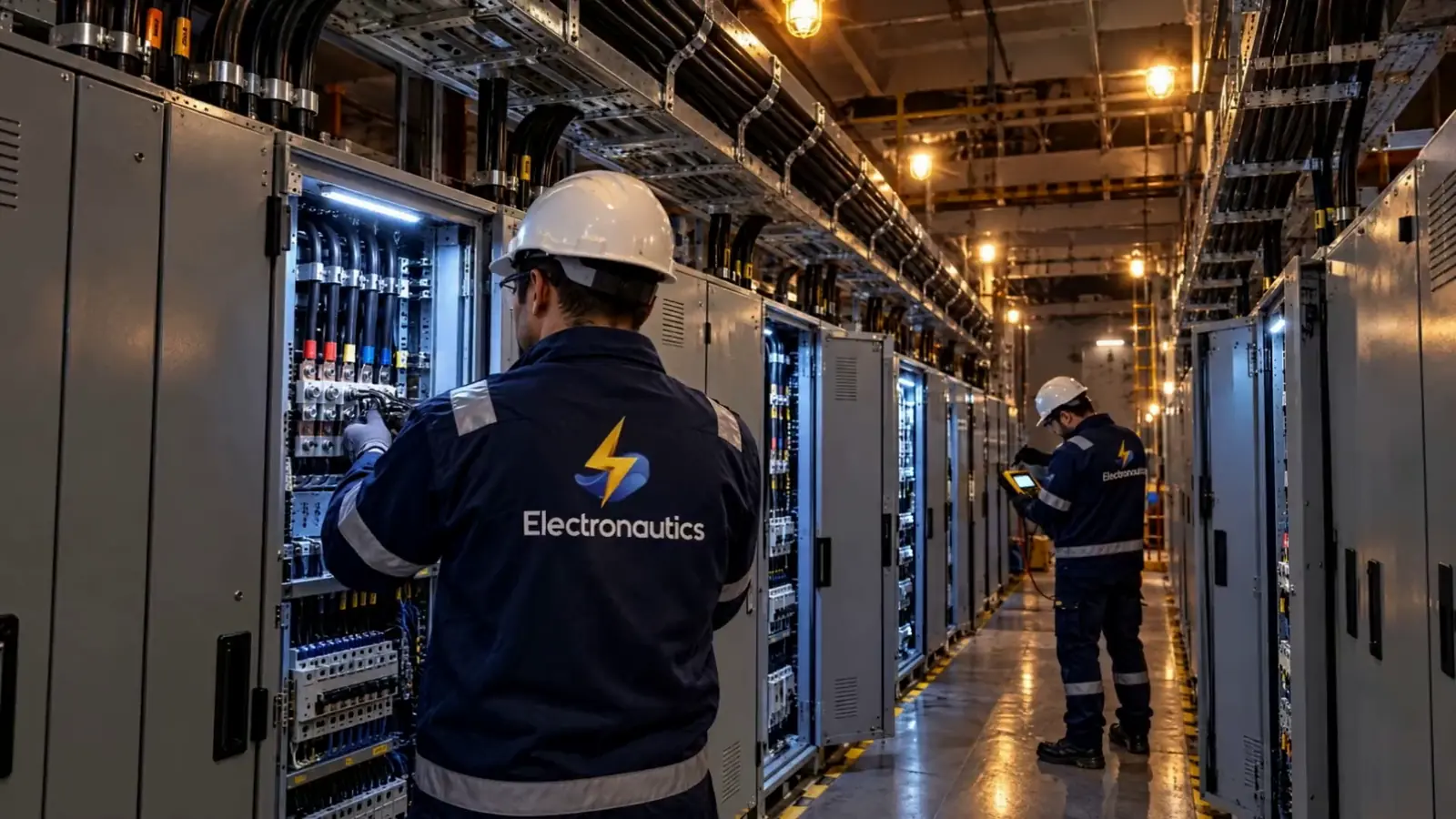
IEC 60092 is the international series of standards for electrical installations in ships. It covers definitions, system design, cables, cable installation and high-voltage systems. It usually becomes binding through the rules of the classification society and the building contract. For work on board, three things therefore always count: the edition of the standard, the class and the shipyard's specification.
01What is IEC 60092?
A series of standards, each with its own number and its own edition. Parts 101 and 201 cover fundamentals and system design, the 300 series covers cables and their installation, Part 401 the completed installation, and the 500 series special cases such as tankers, high-voltage systems and automation1,2,5,15. One part can be revised without the others changing. That is why it is not enough to write just “IEC 60092” in the contract.
A standard is not a law in itself. In the USA, individual parts are binding through references in federal law15. Otherwise they usually apply because class rules and building contracts refer to them.
02Which parts matter for installation and cables?
For work on board, these parts matter most. The editions listed are those we found in the sources cited:
| Part | Contents | Edition |
|---|---|---|
| IEC 60092-101 | Definitions and general requirements, for example the documentation of modifications | Edition 5.0, October 20181 |
| IEC 60092-201 | System design: types of distribution system, insulation monitoring, documentation | Edition 5.0, September 20192 |
| IEC 60092-352 | Selection, installation and operating conditions of cables | Edition 4.0, October 20253 |
| IEC 60092-354 | Power cables, 6 kV to 30 kV | 2020 edition according to IACS UR E118 |
| IEC 60092-376 | Control and instrumentation cables, 150/250 V | Edition 3.0, May 20176 |
| IEC 60092-379 | Data cables up to 1000 MHz, for example for Ethernet | Edition 1.0, July 20247 |
| IEC 60092-401 | Installation and testing of the completed installation | cited as a reference standard in IEC 60092-352:20253 |
| IEC 60092-503 | AC systems above 1 kV up to 15 kV | 2007 edition5 |
IEC 60092-201 is an example of how content moves between the parts: the section on cables was moved from there to IEC 60092-4012. In addition, there are two standards outside the series: IEC 60533 for electromagnetic compatibility on board16 and IEC 60945 for navigation and radiocommunication equipment17.
03What is new in the 2025 edition of IEC 60092-352?
A new title, a scope up to 18/30 (36) kV and new requirements, among others for category and fibre optic cables. The 2005 edition was withdrawn on 23 October 20254. Edition 4.0 is now titled “Selection, installation, and operating conditions of cables”, covers voltages up to 18/30 (36) kV and contains new requirements for category cables up to 1000 MHz, for fibre optic cables and for transitions into hazardous areas3. The bending radii are still given in separate tables for cables up to 1.8/3 kV and from 3.6/6 kV3.
For ongoing projects, the edition named in the building contract is the one that counts. New contracts should state the edition explicitly.
04What are IACS requirements, and do they apply automatically?
IACS is the umbrella association of the major classification societies. Its members apply its “Unified Requirements” (UR) from fixed effective dates. UR E11 Revision 4, for example, applies to ships with a building contract dated 1 July 2022 or later8. The URs are a common minimum basis. Individual class societies can set different or stricter values. Lloyd's Register, for example, gives different values from E11 for the voltage test of high-voltage cables8,9.
For electrical installation work, these URs matter most8,11,12:
| Requirement | Contents |
|---|---|
| UR E7 | Cables must be type approved. IEC 60092-350, -352, -353, -354, -360, -370 and -376 are recognised. |
| UR E10 | Tests for the type approval of control, monitoring and protection equipment |
| UR E11 | High-voltage systems, including the testing of cables after installation |
| UR E13 | Rotating machines |
| UR E15 | Circuit integrity of cables in a fire, to IEC 60331 |
| UR E16 | Plastic cable trays and ducts |
| UR Z23 | Register of watertight cable transits |
| UR Z28 | Survey of watertight cable transits |
05What applies when IEC and class conflict?
At acceptance, the ship's class is what counts, and the building contract can set stricter values. It is not unusual for the sets of rules to differ. Two examples:
- Metal clips: IEC 60092-352:2005 requires supplementary metal clips where plastic cable ties are used on runs other than horizontal cable trays, at intervals of no more than 1 m18. Lloyd's Register specifies 2 m10.
- High-voltage test: For a 6/10 kV cable, IACS E11 specifies 24 kV DC, Lloyd's Register 25.2 kV. With AC, E11 permits a 5-minute test, Lloyd's Register only the 24-hour test8,9.
Where values differ, the applicable value belongs in the specification before work starts. That saves the discussion at acceptance.
06Which components need type approval?
For the electrical installation, mainly the following8,11,13,14:
- Cables: type approved by class to UR E7.
- Plastic cable trays and ducts: type tested to UR E16.
- Watertight cable transits: with a type approval recorded in the shipyard's register to UR Z23.
- Navigation equipment: approved by the flag state under SOLAS Regulation V/18.
- On EU ships: in addition, the wheel mark under Directive 2014/90/EU.
A type approval can come with conditions, for example for certain installation situations19. Anyone who installs an approved product differently from the way described in the approval is not covered by it.
07What evidence is required at acceptance?
Test reports for every installation that is newly built or modified on board. Taking the rules of Lloyd's Register, IACS and IEC as examples1,2,9,11:
- Insulation resistance test of all circuits
- Test of earth conductors and equipotential bonding
- Voltage test of the high-voltage cables, with insulation resistance tests before and after
- Attenuation test reports for the fibre optic cables
- Installation data of the cable transits for the shipyard's register
- Documentation of modifications to existing installations
- Reports of factory tests, harbour trials and sea trials in the ship's documentation
Under Lloyd's Register rules, all tests before commissioning are carried out to the satisfaction of the Surveyor9. How the tests are carried out in detail is covered in the articles on high-voltage testing and OTDR measurement.
08Which mistakes should be avoided with standards and class rules?
- Citing withdrawn editions, for example IEC 60092-352:2005 in a new contract.
- Applying the IEC value, although class requires something different.
- Treating the IACS requirement as an upper limit. It is a minimum basis.
- Overlooking the conditions of the type approval, such as the permitted installation situation.
- Incomplete test reports, for example without the measuring instrument, temperature or test voltage.
09How we do it at Electronautics
We terminate at main switchboards and distribution boards, test with documented test reports and carry out acceptance jointly. We terminate and test special cables such as fibre optic and high-voltage cables with our own people. Our quality management system is certified to DIN EN ISO 9001:2015.
IEC 60092 is the basis. What applies on board follows from the edition of the standard, the class and the building contract together. If you fix these three before work starts, you know for every measurement which limit it is assessed against.
Important
Standards and class rules are revised continually. This article gives the editions we were able to verify in the sources. The editions and rules named in your building contract are binding.
Questions about this article: info@electronautics.de
Sources
- IEC 60092-101:2018, edition 5.0, definitions and general requirements law.resource.org ↗
- IEC 60092-201:2019, Edition 5.0, System design law.resource.org ↗
- IEC 60092-352:2025, Edition 4.0, contents and changes cdn.standards.iteh.ai ↗
- IEC Webstore: IEC 60092-352:2005, withdrawn on 23 October 2025 webstore.iec.ch ↗
- IEC 60092-503:2007, systems above 1 kV up to 15 kV law.resource.org ↗
- IEC 60092-376:2017, edition 3.0, control and instrumentation cables law.resource.org ↗
- IEC 60092-379:2024, edition 1.0, data cables (preview) cdn.standards.iteh.ai ↗
- IACS: Requirements concerning electrical and electronic installations, with UR E7, E10, E11, E13, E15, E16 (as of 09/2023) safety4sea.com ↗
- Lloyd's Register, Rules for Ships, Pt 6 Ch 2 Sec 21 ‘Testing and trials’ (July 2022 edition) imorules.com ↗
- Lloyd's Register, Rules for Ships, Pt 6 Ch 2 Sec 11 ‘Electric cables’ (July 2022 edition) imorules.com ↗
- IACS UR Z23 Rev.7 Corr.1 (October 2022) classnk.or.jp ↗
- IACS UR Z28: Surveys of Watertight Cable Transits iacs.s3.af-south-1.amazonaws.com ↗
- SOLAS Chapter V, Safety of Navigation (Consolidated Edition 2024) imorules.com ↗
- Directive 2014/90/EU on marine equipment (MED) eur-lex.europa.eu ↗
- List of IEC standards incorporated into US federal law law.resource.org ↗
- IEC 60533:2015, Edition 3.0, EMC on ships with a metallic hull law.resource.org ↗
- IEC 60945:2002, 4th edition, navigation and radio equipment law.resource.org ↗
- IEC 60092-352:2005, 3rd edition (full text) law.resource.org ↗
- DNV type approval TAF0000147 Rev.2 for a cable transit system cdn.content-publisher.roxtec.com ↗
As of 17 October 2026