 ELECTRONAUTICS
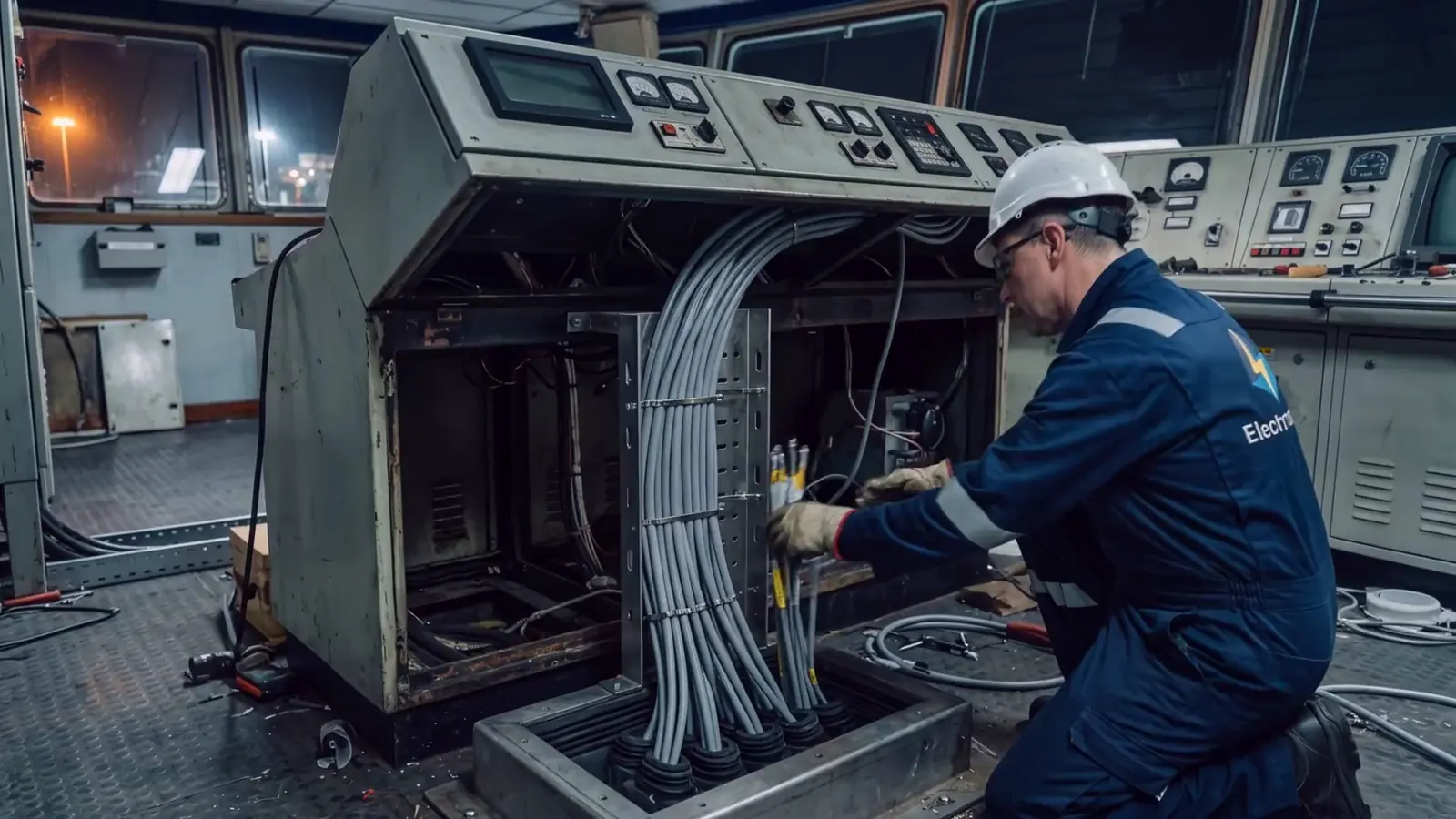
In a bridge refit, the navigation and control equipment on the bridge is renewed. Electrically, that means: remove the old installation, lay new cables, connect and test. The new equipment is governed by SOLAS Chapter V and, on EU ships, by the Marine Equipment Directive; cables and electromagnetic compatibility are governed by the IEC standards.
01What does a bridge refit involve electrically?
Four steps: removal, new cables, connection, testing. The old installation comes out, and new cables are laid to the equipment, sensors and antennas, connected at the console and distribution boards, and tested with a test report. The equipment itself is usually supplied by the manufacturer or the shipyard. Who does what should be clearly allocated before the start: supply of the equipment, cable assembly, connection, commissioning and acceptance.
02Which rules apply to new navigation equipment?
SOLAS Chapter V. Equipment under Regulations 19 and 20 must be type-approved by the flag State. Equipment installed on or after 1 July 2002 must meet the IMO performance standards. Where systems are replaced or added on ships built before 1 July 2002, the same applies, so far as is reasonable and practicable1.
Regulation 19 sets out which equipment a ship needs, by size, type and date of build. Some examples1:
| Equipment | Required from |
|---|---|
| Bridge navigational watch alarm system (BNWAS) | 150 GT |
| 9 GHz radar | 300 GT |
| Gyro compass | 500 GT |
| Second radar | 3000 GT |
| ECDIS | by ship type, size and date of build |
The voyage data recorder (VDR) and AIS are tested annually1.
On ships under an EU flag, Directive 2014/90/EU also applies. Equipment for which international rules require approval must then carry the wheel mark. The requirements in force at the time of installation are decisive3. So the new equipment must meet the requirements that apply when it is installed, not those of the ship's year of build.
03Must the flag or class approve?
Yes, the Administration must approve. Under SOLAS Chapter I, no change may be made to the structure, machinery or equipment after a survey without the approval of the Administration. After repairs or major renewals, an additional survey is due2. Radio installations have their own surveys2.
The Administration is the flag State. How approval works in the individual case and who carries out acceptance should be clarified before the start, not at commissioning. With Lloyd's Register, tests after changes to the electrical installation are carried out before commissioning, to the satisfaction of the surveyor8.
04What applies to interference on the bridge?
Stricter limits than in the rest of the ship. On ships built on or after 1 July 2002, SOLAS Regulation V/17 requires electrical and electronic equipment on and near the bridge to be tested for electromagnetic compatibility. The installation must be carried out so that interference does not affect navigation1.
The relevant standards:
- IEC 60945 is the basic standard for navigation and radio equipment. Its EMC sections also apply to other equipment on the bridge and near receiving antennas. Section 11.2 covers the safe distance to the magnetic compass4. For installation, the standard refers to IEC 60092, IEC 60533 and the manufacturers' manuals4.
- IEC 60533 places the bridge in the “deck and bridge” zone, for which stricter emission limits apply. Transmitters and receiving antennas should be at least 3 m apart. If the distance is smaller, a compatibility analysis is required. Cables outside the ship's structure should have a metallic screen5.
- Cable categories: power, signal, radio and converter cables should be run separately. IEC 60533 recommends separation distances of 10 to 20 cm for this5. There is more on this in the article on cable pulling.
On a bridge that has been retrofitted over the years, it is therefore worth checking the existing cable trays and antennas before the refit: are unscreened cables running next to power cables, are antennas too close together?
05Which cables belong on the bridge?
Type-approved marine cables to IEC 60092. Cables must be type-approved by the classification society12. For control and instrumentation cables, IEC 60092-376 applies: cables for 150/250 V with conductors from 0.5 to 2.5 mm², preferably 0.75 and 1.5 mm², with pair or overall screen, flame-retardant to IEC 60332. They are also available with 90-minute circuit integrity to IEC 603316. For Ethernet and other data cables up to 1000 MHz, IEC 60092-379 has been available since July 20247.
For fibre optic cables, Lloyd's Register requires an attenuation measurement before and after installation, with the record kept on board8. How this is done with an OTDR is covered in the article on OTDR measurement.
06What happens to old cables and penetrations?
That belongs in the contract before removal begins. The contract sets out whether old cables are pulled out completely or disconnected and left in place. How much space remains in cable trays and penetrations for the new cables also matters. If a watertight cable penetration is opened for this, it must be restored in line with the manufacturer's instructions and the type approval. Penetrations are examined at the class renewal survey11.
07Which documents must be correct after the refit?
All documents that describe the electrical state of the ship. Changes to existing installations must be documented and the records kept9. Circuit lists and wiring diagrams on board are brought up to date10. On top of that come the test reports for the new cables and connections.
Anyone tracing a fault on the bridge years later works from these documents. A refit without updated drawings makes the next conversion harder.
08Which mistakes should be avoided in a bridge refit?
These mistakes follow directly from the rules above:
- Cable categories mixed or unscreened cables laid in the bridge zone.
- Screens not terminated correctly.
- Safe distance to the magnetic compass not observed for new equipment.
- Transmitters and receiving antennas too close, less than 3 m apart.
- Equipment without type approval or without the wheel mark installed.
- Work started without approval from flag or class.
- Documents not updated: circuit lists and drawings show the old state.
- Fibre optic cables without an attenuation record handed over.
09What should be settled before the refit?
- Which equipment is coming, and who supplies it
- Who makes up the cables, who connects, who commissions
- Approval from flag and class, and who carries out acceptance
- Time window at the shipyard and access to the bridge
- How old cables and old penetrations are handled
- Cable types, screening and separation by category
- Antenna positions and distances to the magnetic compass
- Which documents are handed over at the end
10How we do it at Electronautics
In a refit, we remove the old installation, lay new cables, connect them and test with a test report. The equipment is supplied by the manufacturer or the shipyard. We wire the bridge and the deckhouse. We also carry out refits on frigates, for example.
A bridge refit is more than swapping equipment. The new equipment needs type approval, the conversion needs the approval of the Administration, and the cables need the right separation and screening. At the end, test reports and drawings must reflect the new configuration.
Important
This article gives a general overview of the rules. Which equipment your ship needs and which approvals are required is determined by the flag State and the classification society.
Questions about this article: info@electronautics.de
Sources
- SOLAS Chapter V, Safety of Navigation (Consolidated Edition 2024) imorules.com ↗
- SOLAS Chapter I, General Provisions imorules.com ↗
- Directive 2014/90/EU on marine equipment (MED) eur-lex.europa.eu ↗
- IEC 60945:2002, 4th edition, navigation and radio equipment law.resource.org ↗
- IEC 60533:2015, Edition 3.0, EMC on ships with a metallic hull law.resource.org ↗
- IEC 60092-376:2017, edition 3.0, control and instrumentation cables law.resource.org ↗
- IEC 60092-379:2024, edition 1.0, data cables (preview) cdn.standards.iteh.ai ↗
- Lloyd's Register, Rules for Ships, Pt 6 Ch 2 Sec 21 ‘Testing and trials’ (July 2022 edition) imorules.com ↗
- IEC 60092-101:2018, edition 5.0, definitions and general requirements law.resource.org ↗
- IEC 60092-201:2019, Edition 5.0, System design law.resource.org ↗
- IACS UR Z28: Surveys of Watertight Cable Transits iacs.s3.af-south-1.amazonaws.com ↗
- IACS: Requirements concerning electrical and electronic installations, including UR E7 (as of 09/2023) safety4sea.com ↗
As of 17 October 2026